

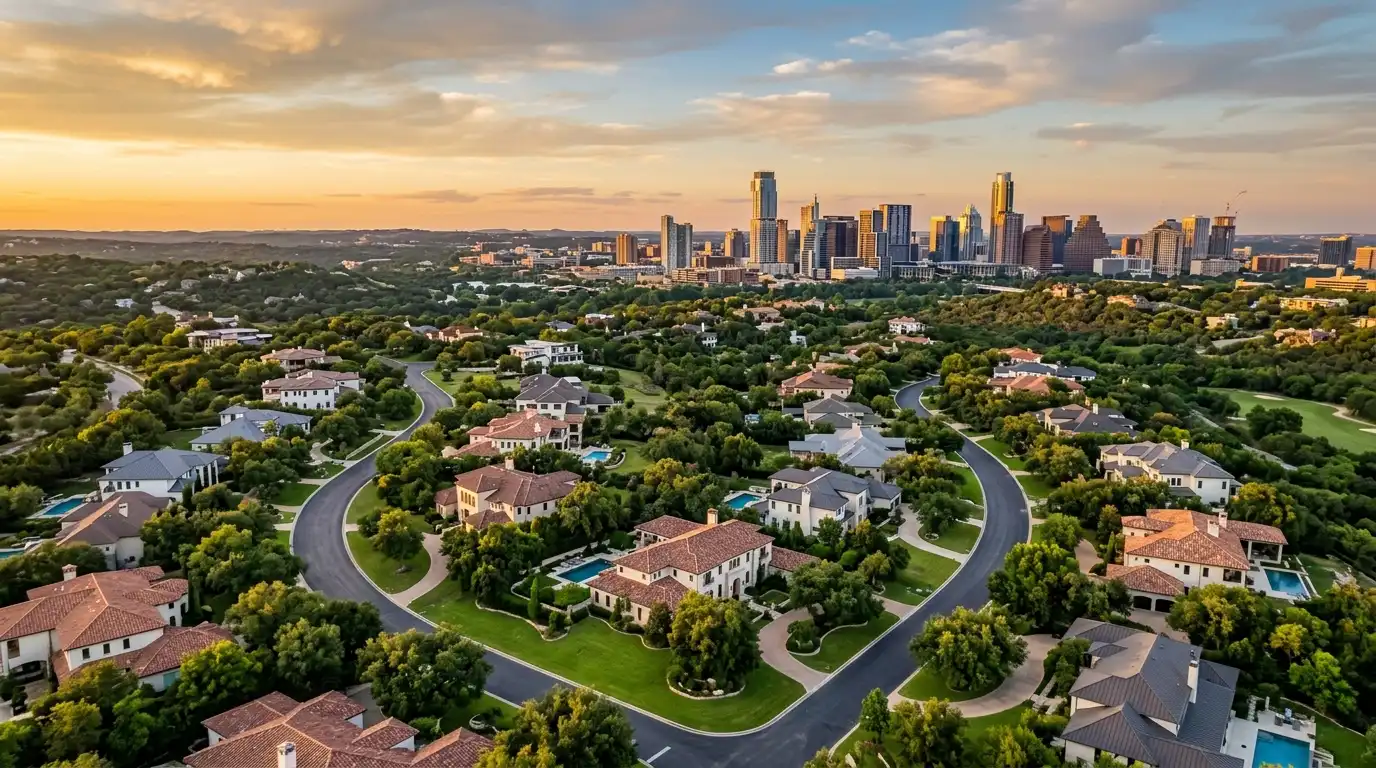
Metro-wide prices, inventory and days on market, the 78746 luxury segment, and relocation demand, current as of mid-2026. From The Speed & Neuren Group at Compass.
This is our quarterly read on the Austin and Westlake real estate market, current as of mid-2026. We are Ross Speed and Lindsay Neuren, Austin natives and the founders of The Speed & Neuren Group at Compass. Between us we have closed more than a billion dollars in Central Texas real estate, and we write this report the way we brief our own clients: the ranges that matter, the trends behind the headlines, and an honest take on what it means whether you are buying or selling.
A note on the numbers below. Local real estate moves quarter to quarter, so we use ranges rather than pinpointing a single month-over-month figure. The values here are illustrative and updated quarterly. For a number you can act on, ask us for a current analysis tailored to your specific property.
Executive Summary: Austin in Q2 2026
The short version: Austin in the second quarter of 2026 is a stable, broadly balanced market, a long way from both the frenzy of 2021 and 2022 and the recession some headlines predicted. Prices across the metro have largely held, inventory has recovered to a healthier level, and days on market have normalized upward from the historic lows. Well-priced homes still sell, and overpriced ones sit, which is exactly how a functioning market is supposed to behave.
The luxury tier, led by Westlake and the 78746 ZIP code, remains the most resilient part of the market. Relocation demand continues to flow in from higher-tax states, providing a floor under prices even as the pace of appreciation has cooled. Our take is that this is a healthy reset toward balance, not a downturn, and that the smartest buyers and sellers are the ones treating it as a market that rewards precision over momentum.
Q2 2026 at a glance (illustrative ranges)
- Metro median sale price: a broad range around the high $400,000s to low $500,000s, roughly flat year over year.
- Inventory: recovered to a healthier, more balanced level after the historic lows of 2021 and 2022.
- Days on market: lengthened from the peak-era lows; well-priced homes still move quickly.
- Westlake / 78746 median: approximately $2.4 million, the highest-priced market in the metro.
- Overall posture: close to balanced, leaning to buyers where inventory is ample and to sellers where supply is tight.
Metro-Wide Trends: Prices, Inventory, and Days on Market
The headline story across the Austin metro is normalization. After the extraordinary run-up of 2021 and 2022 and the correction that followed, the market through the first half of 2026 has settled into a steadier rhythm. We break the three core metrics down below.
Prices Have Largely Held
Metro-wide median sale prices are broadly flat compared with a year ago, sitting in a range around the high $400,000s to low $500,000s depending on the data source and the geography you measure. Some submarkets have eased modestly, others have firmed, but the dramatic double-digit annual swings of the pandemic era are gone. For most owners, that means equity built over the last several years is intact, and for buyers it means pricing has become more predictable.
Inventory Has Recovered
One of the biggest shifts from the peak is supply. Inventory across the metro has rebuilt from the historic scarcity of 2021 and 2022 to a level that looks much more like a balanced market. More choice for buyers is one of the defining features of 2026, and it is the single largest reason negotiating dynamics have shifted in their favor in many segments.
Days on Market Have Normalized
Homes take longer to sell than they did at the peak, when well-located listings sometimes traded in days. That is not a warning sign; it is a return to normal. The pattern we see repeatedly is a tale of two listings: correctly priced, well-presented homes still attract strong activity, while overpriced homes accumulate days on market and eventually cut. Pricing strategy, not market timing, separates the two.
The pricing gap is wider than it looks
In a balanced market the penalty for overpricing is steeper than in a hot one, because buyers have alternatives. The homes that sit longest in 2026 are almost always the ones that launched above what the comparables support, then chased the market down with reductions. Pricing right out of the gate is the difference between a clean sale and a stale listing, and it is where Ross’s appraisal background does real work for our sellers.
The Westlake and 78746 Luxury Segment
If the broader metro is the story of normalization, the Westlake luxury segment is the story of resilience. The 78746 ZIP code that covers Westlake and West Lake Hills remains the highest-priced market in Austin, with a 2026 median around $2.4 million, and the city of West Lake Hills itself running higher, near $2.8 million. Trophy estates, Lake Austin waterfront, and the gated enclaves of Rob Roy and Davenport Ranch trade from $4 million well past $10 million.
What holds this segment up is structural. Top-ranked Eanes ISD, which Niche ranked the number one school district in Texas and seventh nationally for 2026 with all of its schools top-ranked and Westlake High among the top public high schools in the state, anchors family demand. A 10 to 20 minute downtown commute, large wooded Hill Country lots, and a built-out area with very limited new supply all reinforce it. Texas having no state income tax lets high earners direct more income toward housing, which keeps the upper end competitive.
The one honest caveat at the very top: the most expensive homes can sit longer simply because the buyer pool is small and selective. A $7 million estate does not have the depth of demand a $1.5 million home does, so time on market at that level is less a signal of weakness than a feature of the segment. Correctly priced luxury homes in strong locations continue to move, but pricing them takes specific comparables, not a per-square-foot average.
Relocation Demand and Where Buyers Are Coming From
Relocation is the engine that keeps a floor under Austin demand, and it remains active in 2026. The largest inbound flows continue to come from higher-cost, higher-tax states: California leads, followed by the Pacific Northwest, the New York and Northeast corridor, and Illinois. Job growth in technology, professional services, and the broader Texas economy keeps drawing households who want more space, a shorter commute to amenities, and a different tax structure.
The financial math is a big part of the pull. Texas has no state income tax, while California’s top rate reaches 13.3 percent, and a high-earning household can save anywhere from $15,000 to well over $40,000 a year in state income tax by making the move. Higher Texas property taxes claw back part of that, but for many relocating buyers the net still favors Texas, and the equity from a coastal sale buys meaningfully more home here.
In the Westlake area, relocation demand concentrates at the top: executives and tech leaders who target Eanes ISD and the short downtown commute, often paying cash or putting large amounts down. Lindsay leads our relocation work, and the pattern is consistent: these buyers are decisive once they find the right home, but they do their homework first, which is why a clear, honest market briefing matters so much to them.
Why relocation steadies the market
Relocating buyers tend to be less rate-sensitive than local move-up buyers, especially in the luxury tier where cash and large down payments are common. That demand does not evaporate when mortgage rates move, which is one reason the Austin luxury segment has held up better than the rate-sensitive entry tiers. As long as the tax and lifestyle arbitrage from higher-cost states holds, this source of demand is durable.
The Team’s Take: What It Means for Buyers and Sellers
Here is how we are advising our own clients in the current market.
If You Are Buying
You have more leverage than buyers did at the peak. Inventory is healthier, days on market are longer, and sellers of homes that have sat are often open to price reductions and concessions. Use that. Take the time to compare options, lean on real comparables rather than asking prices, and do not be afraid to negotiate. In the luxury tier especially, patience and precision are rewarded.
If You Are Selling
Price right out of the gate. The market still rewards correctly priced, well-presented homes with strong activity, but it punishes overpricing more than a hot market does because buyers have alternatives. The data-driven pricing strategy that Ross’s appraisal background informs is exactly what protects sellers from the stale-listing trap. Presentation and condition matter more now than they did when anything sold.
If You Are Relocating
Model the full picture, not just the headline. The tax and housing arbitrage from California and other high-cost states is real and substantial, but Texas property taxes, in the Westlake area roughly 1.7 to 2.0 percent of assessed value combined, belong in your budget from day one. We walk every relocation client through the complete math before they commit.
How to Get a Custom Market Analysis
A metro headline cannot tell you what your home is worth or what you should pay for a specific property. The Austin market varies sharply by price band, neighborhood, and school zone, and in Westlake two homes a quarter mile apart can differ by millions based on views, lot size, and feeder school. That is why we build custom analyses off the right comparables rather than easy averages.
If you want a current, data-driven read on your situation, whether you are weighing a sale, planning a purchase, or relocating to Austin, reach out. We will give you a clear picture grounded in real comparables, the appraiser-trained pricing perspective Ross brings, and the relocation context Lindsay provides. We update this report quarterly, but your analysis should always reflect today.
Frequently Asked Questions About the Austin Market
How is the Austin real estate market in 2026?
As of mid-2026, the Austin market is stable and balanced rather than the frenzy of 2021 and 2022. Prices across the metro have largely held, with the median sale price in a broad range around the high $400,000s to low $500,000s, depending on the data source and the slice of the market. Inventory has recovered to a healthier level, days on market have lengthened from the historic lows, and well-priced homes still sell while overpriced ones sit. The luxury segment, led by Westlake and the 78746 ZIP code, remains resilient. These figures are illustrative and updated quarterly, so confirm current numbers for your specific area before you act.
Has the Austin market cooled off?
Austin has cooled from its 2021 to 2022 peak, but cooled is not the same as crashed. The pandemic-era spike of double-digit annual appreciation and bidding wars has given way to a more normal market: inventory is up, days on market are longer, and buyers have negotiating room they did not have a few years ago. Prices across most of the metro have flattened or eased modestly rather than collapsing, and demand from relocation and job growth provides a floor. We describe the current market as a healthy reset toward balance rather than a downturn, though conditions vary by price band and neighborhood.
What is happening in the Westlake luxury market?
The Westlake luxury segment, centered on the 78746 ZIP code, remains the most resilient part of the Austin market in 2026. The 78746 median sits around $2.4 million, with the city of West Lake Hills closer to $2.8 million, and trophy estates trading from $4 million well past $10 million. Demand is anchored by top-ranked Eanes ISD schools, a short downtown commute, and limited supply in a built-out area. Inventory at the very top can sit longer because the buyer pool is small and selective, but correctly priced homes in strong locations continue to move. Pricing here rewards precise comparables over averages.
Is it a buyer or seller market in Austin right now?
As of mid-2026, much of the Austin metro is close to a balanced market, leaning slightly toward buyers in segments with ample inventory and toward sellers where supply is tight and demand is strong. Buyers have more choice and negotiating leverage than they did at the peak, including price reductions and seller concessions on homes that have sat. Sellers who price correctly and present well still attract strong offers, especially in sought-after school zones and the luxury tier. The honest answer is that it depends on the price band, the neighborhood, and how a specific home is priced, which is why a local analysis beats a metro headline.
Who can give me a current market analysis for my home?
The Speed & Neuren Group at Compass provides custom, data-driven market analyses for homes across Austin and the Westlake area. We are the number one Compass team in Austin and the Austin Business Journal’s number one real estate team four consecutive years from 2022 to 2025, with more than $1 billion in combined sales. Co-founders Ross Speed and Lindsay Neuren are Austin natives. Ross began his career in appraisals, which gives the team a precise, comparables-based approach to valuation that a generic online estimate cannot match, while Lindsay’s relocation expertise frames how outside demand affects your value. Reach out for a current analysis tailored to your specific property.
Want a Current Analysis for Your Specific Home?
Ross, Lindsay, and the team will give you a clear, data-driven read on your property or your purchase, grounded in real comparables. Let’s talk about your move.
Contact The Speed & Neuren Group
Social Cookies
Social Cookies are used to enable you to share pages and content you find interesting throughout the website through third-party social networking or other websites (including, potentially for advertising purposes related to social networking).